
Where does the flying fox go?
Spoiler alert: the flying fox goes to forests, farms, and even (surprise!) cities.

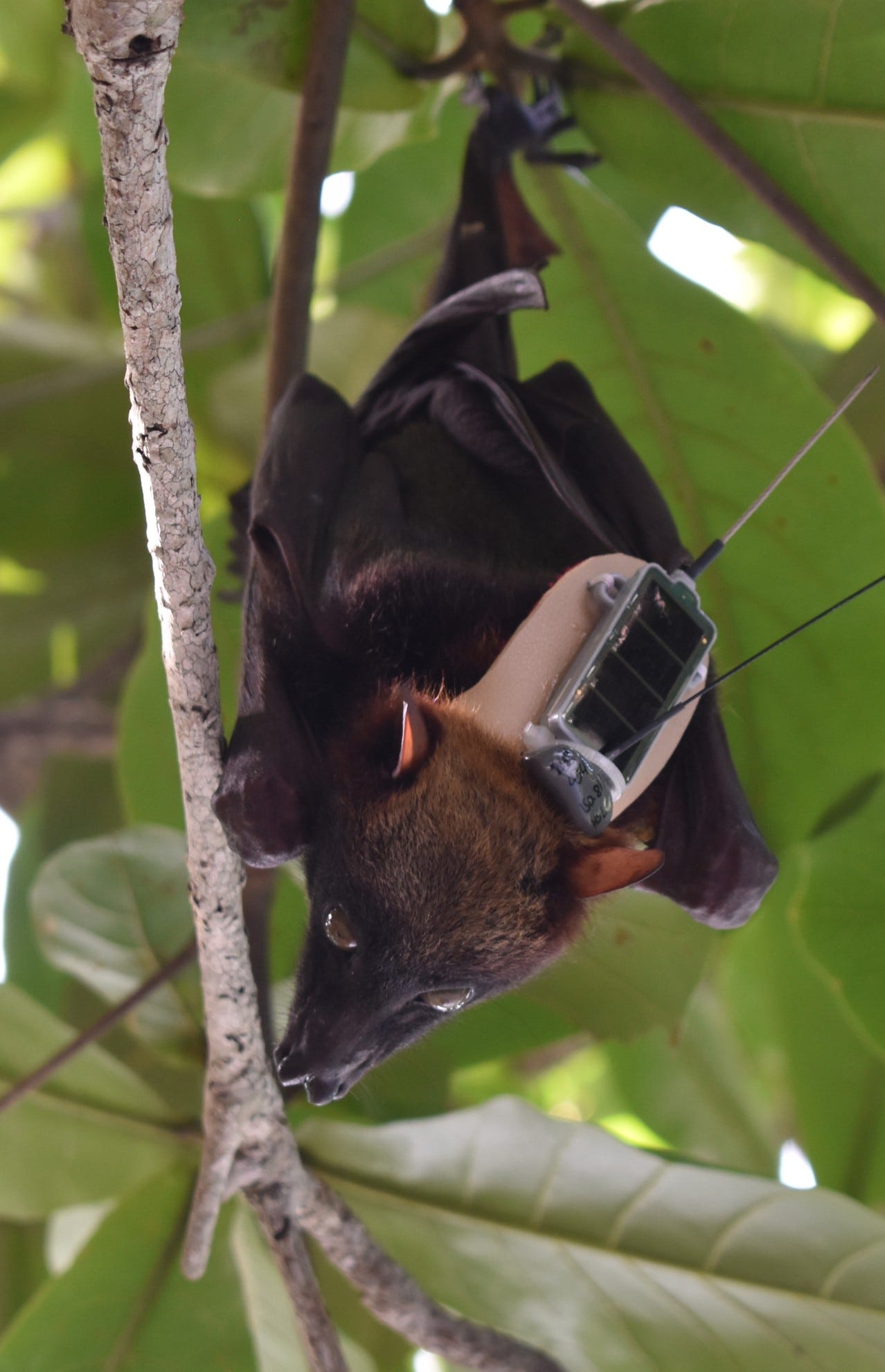
(This article is a breakdown of our recently published article about the movements of flying foxes in the Philippines. Read the full paper here.)
Imagine your dog had the wingspan of an eagle. Now imagine it ate nothing but fruit for breakfast, lunch, and dinner. Congratulations! You’ve successfully pictured a flying fox – also known locally as kabog – in your head.
These strange yet endearing creatures are in reality oversized fruit bats. Their curious orb-shaped eyes let them see clearly with only moonlight as their guide. The largest have the wingspan of an eagle. During the day, they sleep hanging upside down from high branches in screeching congregations called roosts. These gatherings can number well into the thousands. When masses of bats liftoff in such numbers, they form a river of wings in the sky, a mammal pandemonium swirling blackly into the night.
Off the flying foxes go into the dark, and then – a mystery. In a few minutes, even the most robust specimen is nothing but a rapidly disappearing speck on the horizon.
Where do they go? Although this might seem like a purely philosophical consideration, there are practical implications as well. For one, flying foxes are crucial seed-dispersers. After eating, they poop out seeds, usually a considerable distance away from the original tree where they found their meal. Studying the movements of flying foxes helps us understand how far they can propagate new seedlings, and how they might help forests recover from disturbances such as typhoons and logging.
For another, flying foxes can be host to a diverse array of zoonotic pathogens. In other words, viruses, bacteria, and similar microbes which can spread from animals to humans. By knowing the kinds of places flying foxes visit, we can also pinpoint likely areas where they might come into contact with people, and so better understand the threat of potential future outbreaks.
Any sound wildlife management plan for flying foxes must balance minimizing disease risk with conservation, particularly in the context of the important roles they fulfill in tropical ecosystems. And to have a solid foundation for such a plan, we need to know how they move around the landscape.
To find an answer, my colleagues and I – a diverse team of researchers from the University of the Philippines Los Baños and Diliman, the Duke-NUS Medical School, the Uniformed Services University, and the Research Institute for Tropical Medicine – attached GPS collars to a select number of flying foxes at two known roost sites in Luzon. The first site can be found in a river valley in the municipality of Agno, Pangasinan, while the second lies within the BIPCO Bat Sanctuary and Mangrove Eco-Park, in the municipality of Infanta, Quezon.
The flying foxes’ collars recorded their movements at night. Then, during the day, we approached them with antennas in hand in the hopes of downloading data from the animals’ devices as they slept – assuming, of course, that they hadn’t flown off to an entirely different roost during the night. (Spoilers: they frequently did).
Data-gathering involved long bouts of fieldwork spread out across two years of research. At the BIPCO Bat Sanctuary in Quezon, this meant staying at an isolated wood-and-concrete watchtower surrounded by acres of glittering mangrove forest for up to a month at a time.
Thousands of flying foxes roosted a stone’s throw away from the tower, their riotous screeching serving as an alarm clock at dawn. During the late afternoon, we’d patrol nearby rivers and streams on small boats, trying to locate one of the collared bats. A brackish world: steaming heat, the odd crab, a night heron slinking away across the mud, the water catching the sun like a mirror as the day gasped its dying fire.
We ultimately tracked eight individuals belonging to three different species: the golden-crowned flying fox, Acerodon jubatus, endemic to and found only in the Philippines; the large flying fox, Pteropus vampyrus; and the small flying fox, Pteropus hypomelanus.
The ecology of these species remains inadequately understood. For example, only two studies have been published about the movements of Acerodon jubatus and Pteropus vampyrus across the Philippines, both focused on the same population of bats in Subic, which forms just a portion of the species’ full geographic range.
Meanwhile, so far as we can tell, no studies at all have been published describing the movements of Pteropus hypomelanus, in the Philippines or elsewhere.
Our efforts bore fruit. For one, we recorded many of the flying foxes’ nightly sojourns. A particularly intrepid individual flew fifty kilometers over the course of a single night, soaring from the foothills of Antipolo all the way to a remote slope of the Sierra Madre mountain range. We recorded another individual crossing the seas between Polillo Island and Quezon’s eastern coastline, then casually taking a return trip the next night, all while navigating under the pale light of the moon.
Additionally, from our data, it appears that flying foxes tend to revisit the same foraging sites, perhaps because they keep returning to the same feeding ground until it’s exhausted. Conversely, they seldom stayed at any particular roost for long. They frequently switched locations from one far-flung address to another, and we identified at least a dozen new roost sites previously unrecorded by scientists.
It’s behavior similar to that observed by another study which focused on Australian flying foxes, which concluded that these large fruit bats were nomadic creatures that wandered about as they followed ephemeral food sources. After all, trees only fruit for a certain period of the year, and once a patch of forest dries up, it’s time to move on to greener pastures.
But perhaps most importantly, while we observed that flying foxes spent quite a bit of time in the forest, they also frequented cropland while foraging. They even repeatedly ventured into residential streets. We personally visited some of these places, and noted the presence of planted mango, chico, and papaya trees. One of the farms we visited also housed a few pigs, something to note, given there have been past zoonotic outbreaks which involved domestic livestock as intermediate hosts. From flying foxes, zoonotic pathogens first hopped on to livestock like pigs and horses, and from there to humans.
While their presence in heavily settled areas may not be so surprising for Pteropus vampyrus and Pteropus hypomelanus, which have broad diets that include agricultural crops such as durian, it’s something we didn’t expect for Acerodon jubatus; the same individual that inhabited the outskirts of Antipolo for a few days before departing for the Sierra Madre belonged to this latter species. Acerodon jubatus has long been characterized as a forest obligate that relies mostly on wild figs for its diet.
From our results, one might think that flying foxes are more resilient to disturbance than previously assumed. For example, Acerodon jubatus is listed as endangered on the IUCN Red List, largely because the lowland forest it so strongly relies upon is continually threatened by rampant destruction. But if this flying fox can forage in agricultural land, maybe it’s not as threatened as we thought?
We caution against such conclusions, which are premature at best. Extensive studies in Australia and Bangladesh, drawing upon both historical records and modern data, have concluded that flying foxes are increasingly found near human settlements, not because they like the fruit grown in orchards and backyards, but because the forests they otherwise prefer have been largely destroyed. Farmed fruit isn’t always the best diet for flying foxes, and nutritionally deficient bats are also more vulnerable to disease. What we interpret as resilience may also be a desperate compromise in the face of widespread and ongoing habitat loss.
Ultimately, it’s important to remember that only a select number of individuals were tracked for our study. While our results are intriguing, it’s far too early to make any sweeping generalizations about the wider population.
Much more research is needed before anyone can say, with certainty, that what’s happening to the flying foxes of Australia and Bangladesh is also happening in the Philippines. That said, one thing’s for sure: human health is inextricably linked with the well-being of our ecosystems, and we harm our forests at our peril.
Again, the question: where do flying foxes go? You might say, an unexplored slope of the Sierra Madre mountain range, a rural orchard, maybe even the mango tree in your aunt’s backyard. As much new information our study managed to reveal, there remain many more mysteries left to uncover.
If there’s anything our research as taught me, it’s that, like humans, who must navigate busy streets to and from work, flying foxes commute as well. Liftoff, the search for figs and guavas, then the long glide home; the usual flying fox workday.